ICO/FICO Step 1 Part A — What Nobody Tells You Before the Exam
I remember the first time I looked at the ICO/FICO Part A syllabus properly. Anatomy. Embryology. Genetics. Biochemistry. Microbiology. My first thought was, wait, am I giving MBBS again?
If you’ve had that same moment of panic, you’re not alone. Almost every ophthalmology resident feels it. But here’s what I wish someone had told me earlier: Part A is actually one of the more manageable exams once you understand what it’s really testing and how to prepare for it smartly.
I’ve seen so many colleagues stress over this paper unnecessarily. The ones who passed didn’t have more time than you. They just prepared differently. This is what actually works.
So What Is This Exam Actually About?
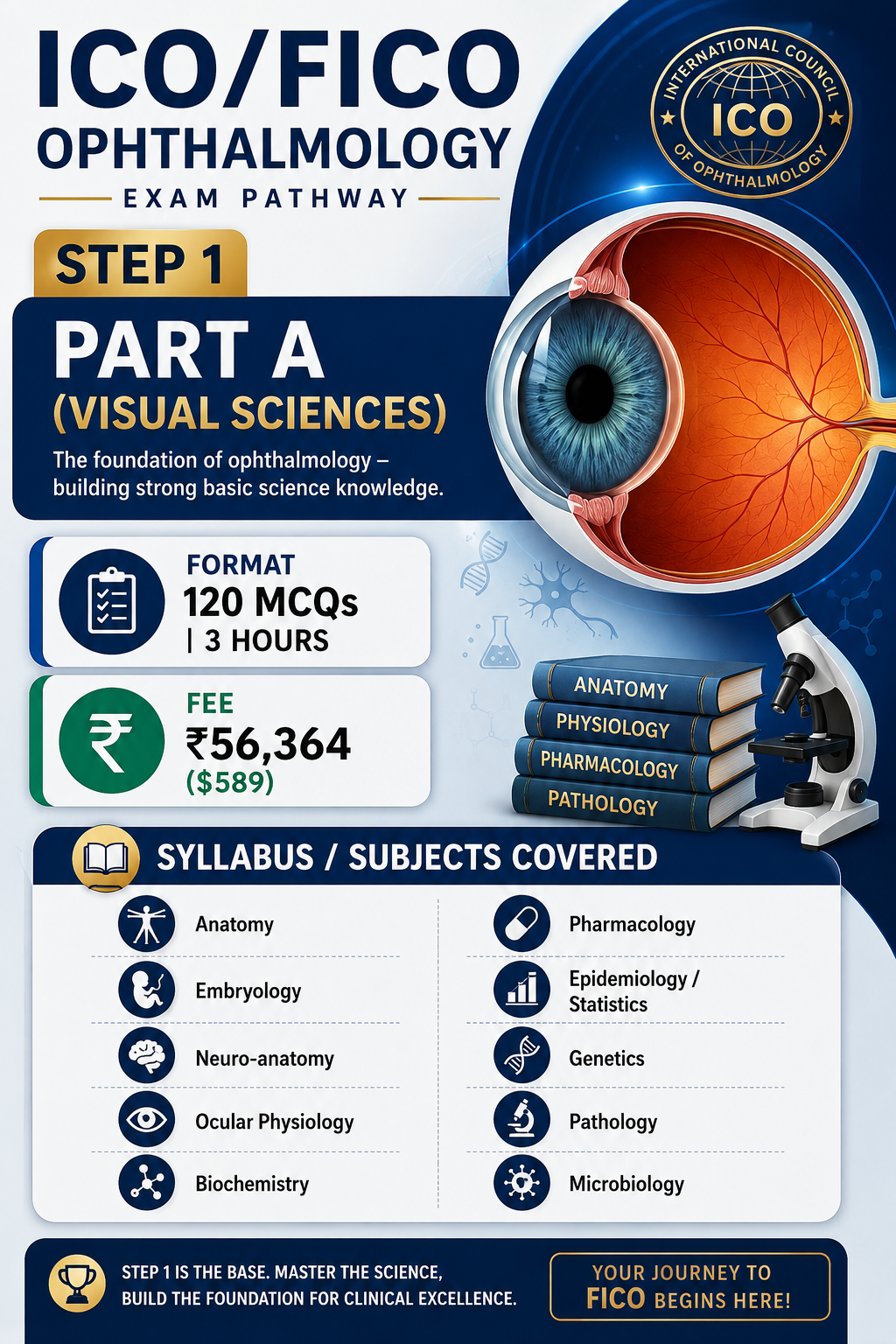
The ICO/FICO Step 1 Part A is called the Basic Visual Sciences paper. 120 questions, 3 hours, covering the foundational science behind everything we do as ophthalmologists.
Think of it this way. Before the ICO trusts you to manage complex eye diseases internationally, they want to know you understand why things happen. Why does aqueous humor build up in glaucoma? How does that anti-VEGF drug actually work? What went wrong developmentally to cause a coloboma?
Once you reframe it that way, the exam stops feeling random and starts making sense.
The basics:
Format: 120 MCQs in 3 hours
Fee: ₹56,364 (about $589)
Subjects: 10 total, but don’t let that number frighten you
The 10 Subjects and What You Actually Need to Know
Yes, there are 10 subjects on paper. But in reality, 3 of them will make or break your score: Anatomy, Ocular Physiology, and Pharmacology. Get these right and you’re already ahead of most candidates.
The full list: Anatomy, Embryology, Neuro-anatomy, Ocular Physiology, Biochemistry, Pharmacology, Epidemiology and Statistics, Genetics, Pathology, and Microbiology.
The good news? A lot of this overlaps. Embryology connects to Anatomy. Pharmacology connects to Physiology. Once you build the core understanding, the rest falls into place faster than you expect.
One thing that genuinely helps here is having the syllabus broken down topic by topic with MCQs mapped to each area. That’s exactly how www.ophthamcq.com is structured — so you’re never guessing what to study next.
The Topics That Keep Showing Up
After going through past ICO/FICO papers, these are the areas that come up time and time again. If you’re going to prioritise anything, let it be these.
Anatomy
The visual pathway, orbital anatomy, blood supply of the retina, layers of the cornea, extraocular muscles. Draw these out. Understand the 3D relationships. The questions are rarely “name this structure.” They’re more “what happens when this structure is damaged.”
Ocular Physiology
Aqueous dynamics, accommodation, dark adaptation, color vision. The exam loves to test mechanisms, not just facts. Why does timolol lower IOP? How does the pupil react in a relative afferent pupillary defect? That kind of thinking.
Pharmacology
Know your anti-glaucoma drugs cold. Mechanism, side effects, contraindications. Add mydriatics, cycloplegics, anti-VEGFs, and steroids. This section rewards candidates who understand drugs, not just remember their names.
Embryology
Coloboma, PHPV, Peters anomaly. The developmental conditions that keep appearing. Trace how the eye develops and the anomalies fall into place naturally.
Genetics
Inheritance patterns of retinitis pigmentosa, Stargardt disease, Best disease. Which chromosome, which gene, which pattern. Keep a simple table. It saves enormous time during revision.
If any of these feel weak right now, the topic wise MCQ packs on www.ophthamcq.com are genuinely worth going through. Each question comes with a proper explanation so you’re building understanding, not just clicking answers.
“The people who pass aren’t the ones who read the most. They’re the ones who practiced the most and actually understood what they were practicing.”
The Right Books for ICO/FICO Part A
Most people start with the wrong books and waste weeks. Here’s what actually works, based on candidates who’ve sat and passed this exam.
First: Ferris — Basic Sciences in Ophthalmology by John Ferris
If you’re short on time, this is the one book you need. It’s old, yes, but anatomy and basic sciences haven’t changed. Candidates who’ve passed report that most of their exam topics came directly from this book. It contains over 500 MCQs in true/false format and covers every subject in the Part A syllabus. Start here, always.
Second: Khurana — Anatomy and Physiology of the Eye by AK Khurana
This is one of the officially recommended books for ICO/FICO Part A. Written specifically for postgraduate students in ophthalmology, it covers both anatomy and physiology in a continuous, interrelated way across 14 chapters. The language is clear, the diagrams are good, and it’s particularly strong on the two highest yield areas of Part A. If Ferris gives you the MCQ sharpness, Khurana gives you the depth.
If You Have Extra Time: AAO BCSC Section 2
The American Academy of Ophthalmology Basic and Clinical Science Course Section 2 is a great supplement if you have time. Don’t make it your primary resource. It’s detailed and takes time. But it adds real depth if you want to truly understand, not just pass.
The Order That Works
Start with Ferris to get your MCQ instincts going and your syllabus mapped. Use Khurana to go deeper on Anatomy and Physiology. Fill gaps with AAO if time allows.
And for past papers and topic wise MCQ practice without hunting across multiple books, www.ophthamcq.com has everything in one place, structured exactly around the Part A syllabus.
How to Actually Prepare — Honestly
Here’s what works. Not what sounds good in theory. What actually works.
1. Go topic by topic, not all over the place
Jumping between subjects feels productive but it isn’t. Pick Anatomy, finish it properly, do the MCQs, then move on. Structure your weeks around one topic at a time.
2. Do MCQs while you study, not after
This is the biggest mistake most people make. They read an entire chapter, feel confident, then open an MCQ app and get half of them wrong. Practice as you learn. Read a concept, immediately test yourself on it. The retention is completely different.
3. Stop reading textbooks for last minute revision
Ferris and Khurana are brilliant. But 400 pages two weeks before the exam? Not the move. You need short, focused, exam ready notes that give you exactly what you need without the noise. The handwritten style revision notes on www.ophthamcq.com were built for exactly this moment.
4. Take past papers seriously
The ICO/FICO doesn’t repeat exact questions but it absolutely repeats concepts and question styles. Candidates who practice past papers walk into the exam feeling like they’ve seen it all before. Because in many ways, they have. Past year ICO/FICO papers are available on www.ophthamcq.com — this is honestly one of the most valuable things you can access during prep.
5. Last week — only revision, nothing new
Starting a new topic 5 days before the exam is panic studying. It rarely helps and often hurts your confidence. Revise what you know, do full timed mocks, sleep properly. That’s it.
How Much Time Do You Need?
If you’re in active clinical practice, 6 to 10 weeks of consistent preparation is realistic. If you’ve recently finished residency and the basics are fresh, 4 to 6 weeks can be enough.
The magic number isn’t weeks. It’s daily hours. Even 90 minutes a day, done consistently, is more effective than cramming 8 hours on weekends. Your brain needs time to consolidate what it’s learning.
One rule to live by: at least 60% of your prep time should be MCQ practice, not reading. The exam is 120 MCQs. Train the way you’ll perform.
The App That’s Actually Built for This Exam
Most medical apps are generic. They cover everything loosely and nothing deeply. OphthalMCQ is different. It was built specifically for ophthalmology fellowship exams including ICO/FICO Part A.
Here’s what makes it genuinely useful.
Past year ICO/FICO papers are available. This alone is worth it. MCQs are mapped exactly to the Part A syllabus so you’re never studying irrelevant content. Recall MCQs cover the most frequently repeated concepts. Image based questions are included because ophthalmology is a visual specialty. Every answer comes with a proper explanation, not just correct or wrong. Handwritten style revision notes on Anatomy, Physiology, Pharmacology and more are short, sharp and exam ready. It works on Android, iOS and directly on the website so you can study on whatever device you have.
The people using it say it best. Doctors call it the best distillation of Ferris and Khurana they’ve ever found. Residents say it’s pure concept building, not just MCQs. Busy clinicians say it actually fits into their schedule.
That’s exactly what it was designed for. Real doctors, real time constraints, real results.
Visit www.ophthamcq.com or search Ophtha MCQ on the Google Play Store or Apple App Store.
ICO/FICO vs FAICO vs FRCOphth A Quick Honest Take
People ask this all the time so let me be straightforward.
The FAICO is India centric, clinically focused, and great if you’re staying in Indian practice. The FRCOphth from the UK is rigorous, highly regarded, and has a demanding basic sciences component in Part 1. The ICO/FICO is internationally standardized, valid in over 100 countries, and sits between the two in terms of style.
If global mobility matters to you, ICO/FICO is one of the smartest credentials you can earn. It travels with you wherever your career takes you.
For whichever exam you’re targeting, www.ophthamcq.com has dedicated MCQ packs and notes for FAICO, ICO/FICO, PDCET and FRCOphth all in one place.
Last Thing You’ve Got This
Part A is not a trick exam. It’s not trying to catch you out. It tests whether you genuinely understand the science behind what you’ll spend your career doing.
Approach it with curiosity, not just anxiety. Do your MCQs. Go through past papers. Use good revision notes. Give yourself enough time.
Most candidates who prepare properly pass. You can be one of them.
Good luck. Your ICO/FICO journey starts here. 👁
Ready to start? Past papers, topic wise MCQs and exam ready revision notes are all waiting at www.ophthamcq.com. Available on Android and iOS too. Built by ophthalmologists, for ophthalmologists.