If you're an ophthalmology postgraduate in India, you've probably heard whispers about a new exam called AIOS-OKAT — and you've probably also noticed that almost nothing online actually explains it properly. Most residents end up prepping with old ICO banks or FRCS material and hoping for the best.
Here's what OKAT actually is, how it's structured, why your score matters more than you'd think, and what to actually do about it.
What Is AIOS-OKAT?
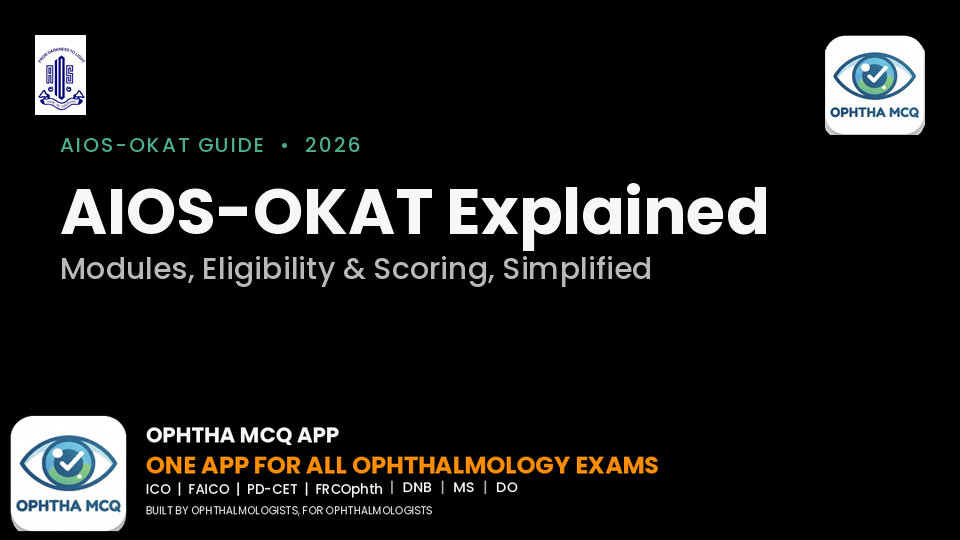
AIOS-OKAT stands for the All India Ophthalmological Society Ophthalmic Knowledge Assessment Test. In AIOS's own words, it "envisages to objectively measure the broad-based ophthalmic knowledge of postgraduate students and report scores relative to their peers."
It's a national, online, standardized MCQ exam, conducted annually in February, mapped directly to the AIOS National Curriculum for Ophthalmology Postgraduate Training — the same curriculum document that governs what your residency program is supposed to teach you in the first place.
In short: this isn't a random test. It's the exam AIOS built to check whether the curriculum is actually landing.
The Three Modules — And They're Not All the Same
OKAT isn't one paper. It's three separate modules, each testing something different:
Module 1 — Foundational Knowledge 150 MCQs, 150 minutes. Basic Sciences, Optics, Refraction, and clinical examination methods. Open from PG Year 1.
Module 2 — Clinical Knowledge 150 MCQs, 150 minutes. Comprehensive ophthalmology and subspecialties, with an emphasis on knowledge — do you know the disease, the finding, the classification. Open from PG Year 2.
Module 3 — Clinical Skills 100 MCQs, 150 minutes. Analytical and clinical problem-solving — can you actually apply that knowledge to a real scenario. Open from PG Year 3 (MD/MS/Primary DNB) or Year 2 (DO/Secondary DNB).
Here's the part almost nobody explains clearly: Module 2 and Module 3 test the exact same subspecialty range. AIOS has never published a separate topic list confining Module 3 to certain subspecialties. What changes is the depth — Module 2 asks "do you know this," Module 3 asks "what would you actually do." The curriculum itself confirms this, grading every subspecialty into PGY1 (basic), PGY2 (standard), and PGY3 (advanced) goals — which lines up exactly with when each module opens to you.
Why Your OKAT Score Actually Matters
This isn't a pass/fail formality. AIOS has built real stakes into it:
- Top 10 first-attempt scorers in each module win registration and travel support to the AIOS Annual Conference, plus a Merit Certificate
- Your OKAT score is one of the criteria used for AIOS National and International Fellowship and Travel Grant selection
- AIOS is actively positioning OKAT as a baseline for fellowship program selection going forward — meaning this score may eventually matter well beyond just the exam itself
You get up to 5 attempts to raise your score for fellowship purposes, but only your first attempt counts for the honours and awards. That first sitting is the one that matters most, and there's no version of "I'll just retake it" that recovers what a badly-prepared first attempt costs you.
The Problem With How Most People Prepare
Since OKAT is new, most postgraduates are stuck cobbling together prep from resources that were never built for it — ICO Part A/B/C material, FRCS banks, whatever PDF got forwarded in the department WhatsApp group. It kind of overlaps. It's not actually mapped to what AIOS is testing, at the depth AIOS is testing it, in the format AIOS uses.
That gap is exactly why we built this.
What We Built Instead
OphthaMCQ is the first and only OKAT-focused course on the internet. Not an ICO bank re-labelled for OKAT — every single question was built from the ground up against the actual AIOS National Curriculum, checked item by item until the checklist was actually covered, not just "seemed relevant."
And it wasn't built by content writers guessing at what the exam might ask. It was built by ophthalmologists who have personally taken and cleared OKAT — people who know its real phrasing style, its actual difficulty level, and what "clinical skills" reasoning genuinely looks like on the paper, because they've sat across from it themselves.
Module 1: Foundational Knowledge is live now — full coverage of Basic Sciences, Optics, Refraction, and every examination technique and instrument in the official curriculum, including image-based questions built from real clinical photographs.
Module 2 & 3: Clinical Knowledge & Clinical Skills are taught as one combined course, deliberately — because they share the same subspecialty curriculum. Every topic is covered in two layers back-to-back: Section A (knowledge-level, mapped to Module 2) and Section B (applied clinical reasoning, mapped to Module 3), so you're not relearning the same subspecialty twice from two disconnected resources months apart.
Where to Start
If you're prepping for OKAT — whether you're Year 1 and just starting Module 1, or Year 2/3 and looking at Module 2 and 3 together — this is built specifically for where you are:
First-attempt performance is what actually counts for the awards. Prepare like it.