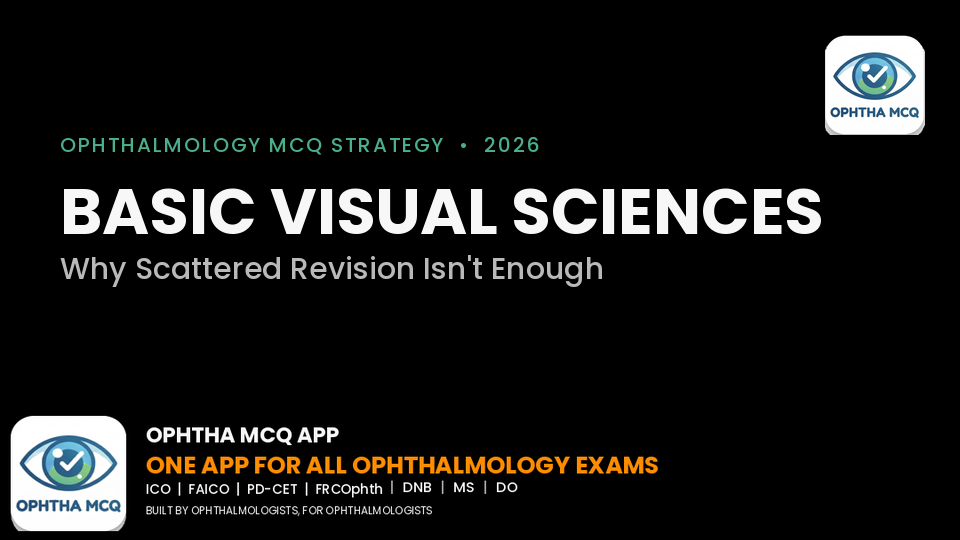
ICO Basic Visual Sciences (Part A) 2026: How to Pass on Your First Attempt
Quick answer: Passing ICO Visual Sciences comes down to three things, knowing the exact exam pattern, 120 single-best-answer questions in 3 hours with no negative marking, covering all nine basic-science subject areas instead of over-focusing on anatomy, and testing yourself on every subject as you learn it rather than saving MCQ practice for after you finish reading.
Know the Exam Pattern Cold
Before building a study plan, lock in the format.
120 questions, single best answer, taken as a computer-marked paper
3 hours total, roughly 1.5 minutes per question
No negative marking, a blank answer scores the same as a wrong one, so never leave a question unanswered
Usually taken early in residency, often in the first year, while MBBS-level basic sciences are still fresh
Tests recall and concept application across anatomy, embryology, physiology, pathology, pharmacology, microbiology, immunology, genetics, and biochemistry
Because there is no penalty for guessing, never skip a hard question outright. Mark your best guess and move on.
Step 1: Map the Nine Subject Areas Before You Start Reading
Anatomy, orbital anatomy, extraocular muscles, cranial nerve supply, lacrimal system, vascular supply to the globe
Embryology, ocular development and developmental anomalies
Physiology, aqueous humor dynamics, intraocular pressure regulation, the visual pathway, dark and light adaptation
Pathology, inflammation, wound healing, degenerative changes, tumor biology
Pharmacology, antiglaucoma drug mechanisms, mydriatics, cycloplegics, antibiotics, corticosteroids
Microbiology, ocular infections and organisms
Immunology, immune-mediated ocular disease
Genetics, inheritance patterns of eye disease
Biochemistry, ocular biochemical pathways
Candidates who spend most of their time on anatomy because it feels like the core subject consistently under-prepare microbiology, immunology, genetics, and biochemistry, four smaller subjects that are still fully weighted on the exam.
Step 2: Give Every Subject Dedicated MCQ Time, Not Just Anatomy
This is where most marks are actually won or lost. Anatomy is the largest subject, but it is not the only heavily tested one. A candidate who scores well on anatomy and poorly on the five smaller subjects combined will still underperform a candidate who is moderately strong across all nine. Treat each subject as its own mini exam, read it, then immediately answer questions on it, before moving to the next.
Step 3: Build Your Reading List in This Order
Standard ocular anatomy texts, for the largest single subject
AAO BCSC fundamentals, for physiology and pathology grounding
Kanski, for high-yield pathology and clinical correlation
Khurana, for consolidated basic sciences with exam-style framing
Forrester, for immunology and pathology depth where needed
Reading theory without immediately testing it is the single biggest time waster candidates report. Pair each subject with MCQs the same day you read it, not weeks later.
Step 4: Practice Under Real Exam Conditions
In the final 2 to 3 weeks before your exam date, time yourself at 120 questions in 3 hours, not per-subject, since the pacing pressure across a mixed nine-subject paper is different from topic-wise practice. Review every wrong answer for the concept you missed, not just the correct option. Redo previous-year and recall-based questions last, closest to your exam date, since these most closely mirror what is actually asked.
Two Resources to Build This Plan Around
For the concept-building phase, the Basic Visual Sciences Exam-Ready Notes with MCQs, https://www.ophthamcq.com/new-courses/54-basic-visual-sciences-notes-with-mcqs-for-ico-of-frcophth, pairs each subject with MCQs immediately after the theory, covering embryology, anatomy, physiology, pathology, microbiology, and pharmacology in one volume.
For the timed-practice phase, the ICO Basic Visual Sciences MCQ Bank, https://www.ophthamcq.com/new-courses/26-ico-basic-visual-sciences-mcqs, gives you previous-year questions, recall MCQs, and image-based concepts across all nine subject areas, built for exactly this kind of timed drilling.
Frequently Asked Questions
How many questions are on the ICO Visual Sciences exam, and how much time do I get?
120 single-best-answer questions in 3 hours, roughly 1.5 minutes per question.
Is there negative marking on the ICO Visual Sciences exam?
No, a wrong answer and a blank answer score identically, so every question should be attempted.
What is the most common reason candidates fail this exam?
Uneven subject coverage, over-preparing anatomy while under-preparing microbiology, immunology, genetics, and biochemistry, which together carry real weight on the paper.
Should I prepare Visual Sciences before or after Optics and Refraction?
Most candidates take Visual Sciences first since it overlaps with fresh MBBS knowledge, then move to Optics and Refraction once they have more time to work through the calculations properly.
What is the fastest way to improve my score in the final few weeks?
Timed full-length practice under real exam conditions, reviewing every miss for the underlying concept rather than just the correct answer, this closes gaps faster than reading more theory at this stage.
Prepare With OphthaMCQ
One App for All Ophthalmology Exams. OphthaMCQ brings together exam-ready notes, MCQs, past papers, and OSCE practice for ICO, FAICO, PD-CET, FRCOphth, DNB, MS, DO, OF, and MAICO/OKAT candidates across 23+ countries. Built by ophthalmologists, for ophthalmologists.
Basic Visual Sciences Exam-Ready Notes with MCQs: https://www.ophthamcq.com/new-courses/54-basic-visual-sciences-notes-with-mcqs-for-ico-of-frcophth
ICO Basic Visual Sciences MCQ Bank: https://www.ophthamcq.com/new-courses/26-ico-basic-visual-sciences-mcqs
Browse all ICO/FICO courses: https://www.ophthamcq.com/new-courses?examId=3
Google Play: https://play.google.com/store/apps/details?id=com.bktxsx.ucjcrq
App Store: https://apps.apple.com/in/app/ophtha-mcq-faico-ico-pdcet-frc/id6759045904