Clearing the theory screening test of the Fellow of All India Collegium of Ophthalmology (FAICO) in Retina and Vitreous is only half the battle. The true differentiator—and where most candidates feel the greatest pressure—is the Stage 2 Practical and OSCE Examination.
Conducted at premier tertiary centers such as LVPEI, the practical examination is designed to test rapid clinical reasoning, precise imaging interpretation, and spot-on Viva delivery under strict timed conditions.
If you are gearing up for the FAICO Retina practical exam, here is an exact breakdown of the station structure and how to build a high-scoring preparation plan.
Understanding the Practical Exam Format
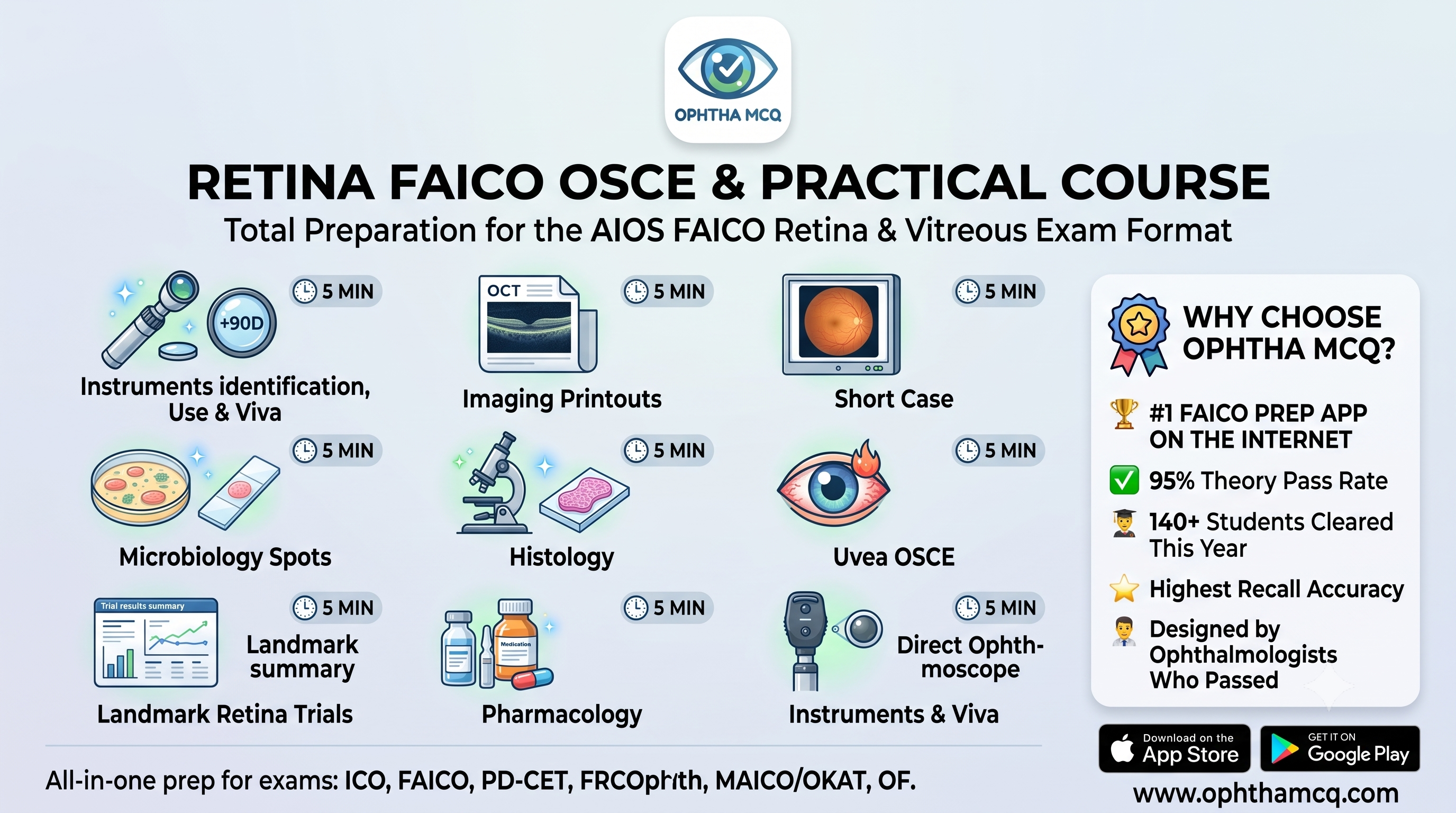
The AIOS FAICO Retina practical examination follows a standardized, fast-paced format:
9 OSCE Stations (5 Minutes Each): These objective structured stations cover short cases, fundus photographs, multimodal imaging printouts (OCT/FFA), ophthalmic instruments, ocular microbiology spotters, and histology slides.
Station 10 (Viva Voce): A comprehensive oral examination where examiners evaluate your clinical decision-making, surgical indications, and command of evidence-based landmark clinical trials.
With a 5-minute bell dictating each station, there is zero margin for hesitation. Your ability to recognize patterns and write down structured answers must be automatic.
High-Yield Breakdown of the OSCE Stations
1. Multimodal Imaging Printouts (OCT, FFA & Fundus Photos)
At least 2 to 3 stations typically feature high-resolution imaging printouts.
What to expect: Optical Coherence Tomography (OCT) line scans and volume maps, Fundus Fluorescein Angiography (FFA) transit phases, and wide-field fundus photography.
Exam tip: Structure your answer in three steps: Description (hyperfluorescence/hypofluorescence patterns or retinal layer changes), Definitive Diagnosis & Differentials, and Immediate Management Plan.
2. Retina Instruments & Optics
A dedicated instrument station tests far more than basic identification.
Key equipment: Indirect and direct ophthalmoscopes, +90D and +78D slit-lamp lenses, scleral depressors, vitrectomy cutters, and gonioscopes.
Viva questions to master: Optical principles, magnification formula, field of view, real vs. virtual image formation, indications, and exact sterilization/disinfection protocols.
3. The Uvea & Microbiology Crossover Stations
Retinal pathologies frequently overlap with posterior uveitis and infectious etiologies. The examiners actively test this intersection:
Ocular Microbiology Spotters: Gram stains, Giemsa stains, fungal KOH mounts, and culture media plates related to endophthalmitis.
Uveitis Scenarios: Infectious vs. non-infectious posterior uveitis, viral retinitis (CMV, ARN, PORN), and toxoplasmosis chorioretinitis.
4. Posterior Segment Histology & Pharmacology
Be prepared for quick spotter questions on:
Retinal histology layers, choroidal vasculature, and pathological slides.
Pharmacology mechanisms of intravitreal anti-VEGF agents, sustained-release steroid implants, and antifungal/antibiotic intravitreal dosing.
Cracking Station 10: The Viva Voce & Landmark Trials
The Viva Voce station tests your maturity as a vitreoretinal specialist. Examiners want to see if your clinical management aligns with established evidence.
Commit the primary protocols, patient inclusion criteria, and key outcomes of major landmark trials to memory:
Diabetic Retinopathy: DRS, ETDRS, Protocol T, Protocol S, Protocol W.
Neovascular AMD: CATT, VIEW 1 & 2, HAWK & HARRIER, TENAYA & LUCERNE.
Retinal Vein Occlusion: BVOS, CVOS, CRUISE, BRAVO, VIBRANT.
Why OphthaMCQ is the #1 FAICO Prep App on the Internet
Preparing for this station-based exam using encyclopedic reference books is inefficient. You need station-simulated learning built around the actual exam format.
That is exactly why OphthaMCQ is universally recognized as the #1 FAICO prep application on the internet. With a 95% theory passing rate and over 140 candidates cleared this year alone, it boasts the highest recall accuracy of any ophthalmology prep resource globally.
The Retina FAICO OSCE & Practical Course on OphthaMCQ is designed exclusively for this challenge, built by ophthalmologists who have actually cleared the FAICO practicals themselves. There is zero AI-generated filler—only high-yield, purely exam-focused content.
What you get inside the course:
9+ Station Simulations: Timed practice across clinical photographs, OCT/FFA printouts, and short cases mirroring past exams.
Instrument & Optics Viva Compendium: Clear breakdown of instruments, optical physics, and frequently asked examiner questions.
Microbiology, Histology & Uvea Modules: Targeted notes on spotters and crossover stations so you never lose easy marks.
Landmark Clinical Trial Summaries: High-yield cheat sheets designed for rapid recall right before your Viva.
Don't leave your FAICO results to chance. Focus on what is actually tested, practice under simulated pressure, and walk into your exam center with absolute confidence.
👉 Start Your Preparation Today: