# AIOS FAICO Practical Exam & OSCE: Most Searched Questions, Recalls, and Exam Pattern
When candidates clear the Stage 1 theory exam for the Fellow of All India Collegium of Ophthalmology (FAICO), their immediate next step is searching the internet for one thing: What actually happens in the FAICO Stage 2 OSCE and Practical Exam?
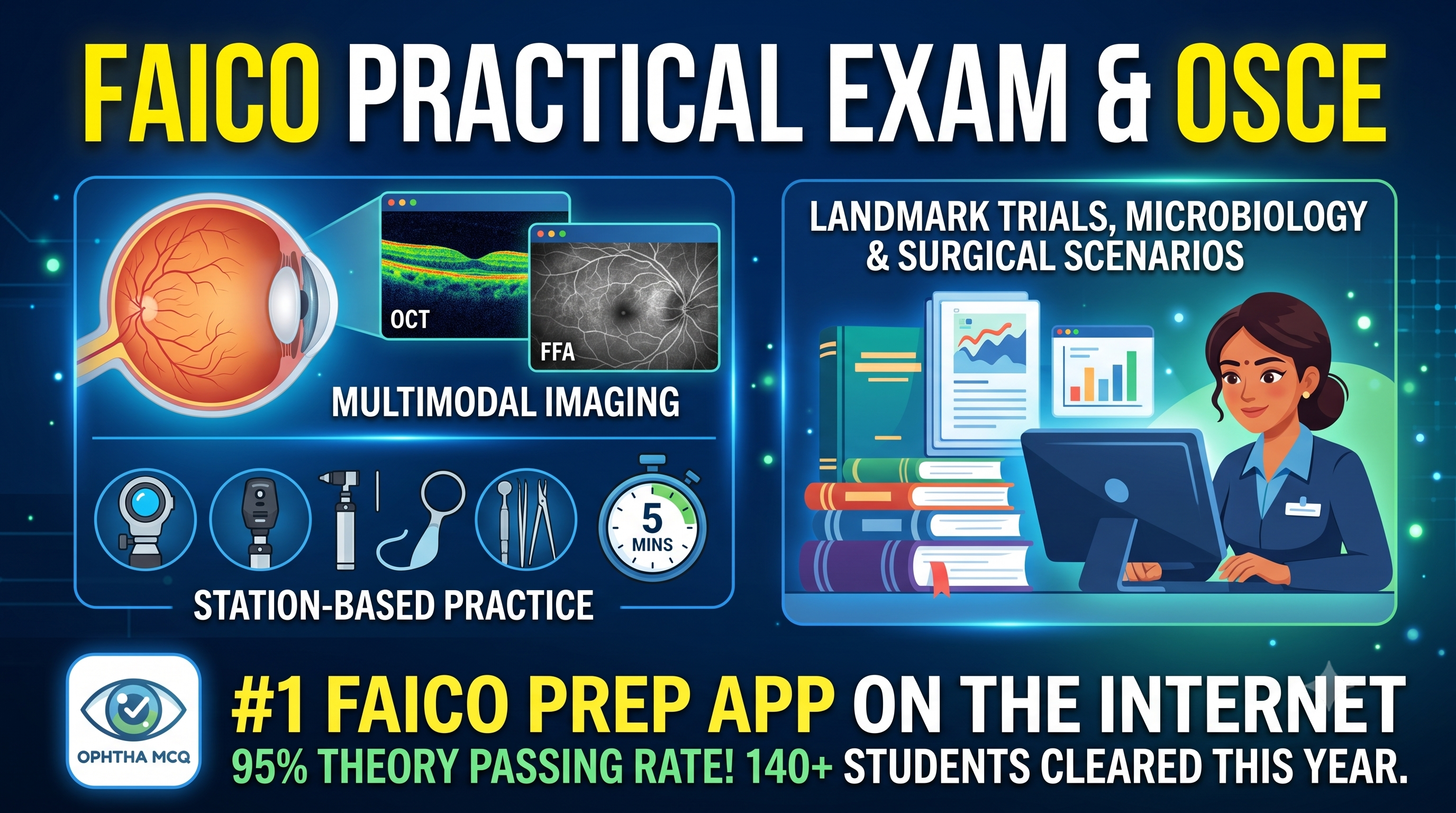
Unlike standard MS or DNB practicals that test general ophthalmology, the FAICO practical is intensely subspecialty-focused. If you are appearing for FAICO Retina and Vitreous, standard textbook reading will not save you. The examiners test clinical decision-making, visual pattern recognition, and evidence-based management—all under a strict 5-minute timer per station.
Based on the most searched queries and recent exam recalls, here is a complete breakdown of what examiners are asking and how you can prepare to pass.
## 1. Multimodal Imaging Printouts (The Highest Searched Topic)
The most common search queries around the FAICO OSCE involve OCT and FFA interpretation. Examiners will hand you high-resolution printouts and expect an immediate, structured response.
Recent Recalls & Tested Areas:
* OCT & OCTA: Identifying Bacillary layer detachments, staging macular holes, tracing choroidal neovascular membranes (CNVM) in AMD, and analyzing Diabetic Macular Edema (DME) patterns.
* Angiography (FFA & ICGA): Differentiating classic vs. occult CNVM, spotting polypoidal choroidal vasculopathy (PCV) on ICGA, and identifying transit phase delays in retinal vascular occlusions.
* Fundus Autofluorescence (FAF): Pattern recognition in inherited retinal dystrophies like Stargardt disease and Best disease.
## 2. Surgical Scenarios & Vitreoretinal Concepts
FAICO candidates are expected to think like practicing vitreoretinal surgeons. You will face clinical scenarios where you must dictate the next surgical step.
Frequently Asked Questions:
* Retinal Detachment: Applying Lincoff’s rules to find the primary break, choosing between scleral buckling and pars plana vitrectomy (PPV), and selecting the appropriate internal tamponade (gas vs. silicone oil).
* Advanced Scenarios: Indications for retinectomy, managing proliferative vitreoretinopathy (PVR), and using perfluorocarbon liquids (PFCL) and retinal dyes during complex surgeries.
## 3. The Instrument Spotters & Optics Viva
You will not just be asked to name an instrument; you will be tested on its physics and protocols.
High-Yield Instruments:
* Wide-field viewing systems (BIOM/Resight) and their optical principles.
* Vitrectomy cutters (guillotine vs. dual-pneumatic) and fluidics.
* Direct and indirect ophthalmoscopes, +90D/+78D slit-lamp lenses, and their respective magnification and field-of-view formulas.
## 4. Landmark Trials and Pharmacology
Examiners heavily test your knowledge of evidence-based medicine in the final Viva Voce station.
Key Preparation Areas:
* Anti-VEGF Protocols: Detailed inclusion criteria and outcomes for trials involving newer drugs like Faricimab and Brolucizumab, alongside established protocols (e.g., Protocol T, CATT).
* Steroid Implants: Indications, duration of action, and side-effect profiles for sustained-release dexamethasone and fluocinolone acetonide implants.
## How to Prepare: Moving Beyond Textbooks
The biggest mistake candidates make is trying to memorize comprehensive textbooks or relying on scattered, unstructured recall PDFs from Telegram groups. A recall only tells you what was asked previously; it does not prepare you for the five different ways that same topic can be tested tomorrow.
To clear the FAICO OSCE, you need visual, station-based practice.
This is why OphthaMCQ is universally recognized as the #1 FAICO prep app on the internet.
Designed by ophthalmologists who have cleared the exam, the Retina FAICO OSCE & Practical Course on OphthaMCQ strips away the fluff. It provides you with the exact simulated environment you need:
* Timed OSCE station practice covering real clinical photographs, OCT/FFA printouts, and short cases.
* Comprehensive Viva guides for ophthalmic instruments and surgical scenarios.
* High-yield cheat sheets summarizing all landmark retina clinical trials and pharmacology.
With a 95% theory passing rate and over 140 students clearing their exams this year alone, OphthaMCQ boasts the highest recall accuracy of any preparation platform.
Stop guessing what the examiners want. Train your clinical reflexes with the right tools.
Start your OSCE preparation today: Access the Complete Retina FAICO OSCE & Practical Course Here (https://www.ophthamcq.com/new-courses/63-retina-faico-osce-%26-practical-course-%7C-ophthamcq)