Ophthalmology instruments and drugs for practical exams and viva
Description
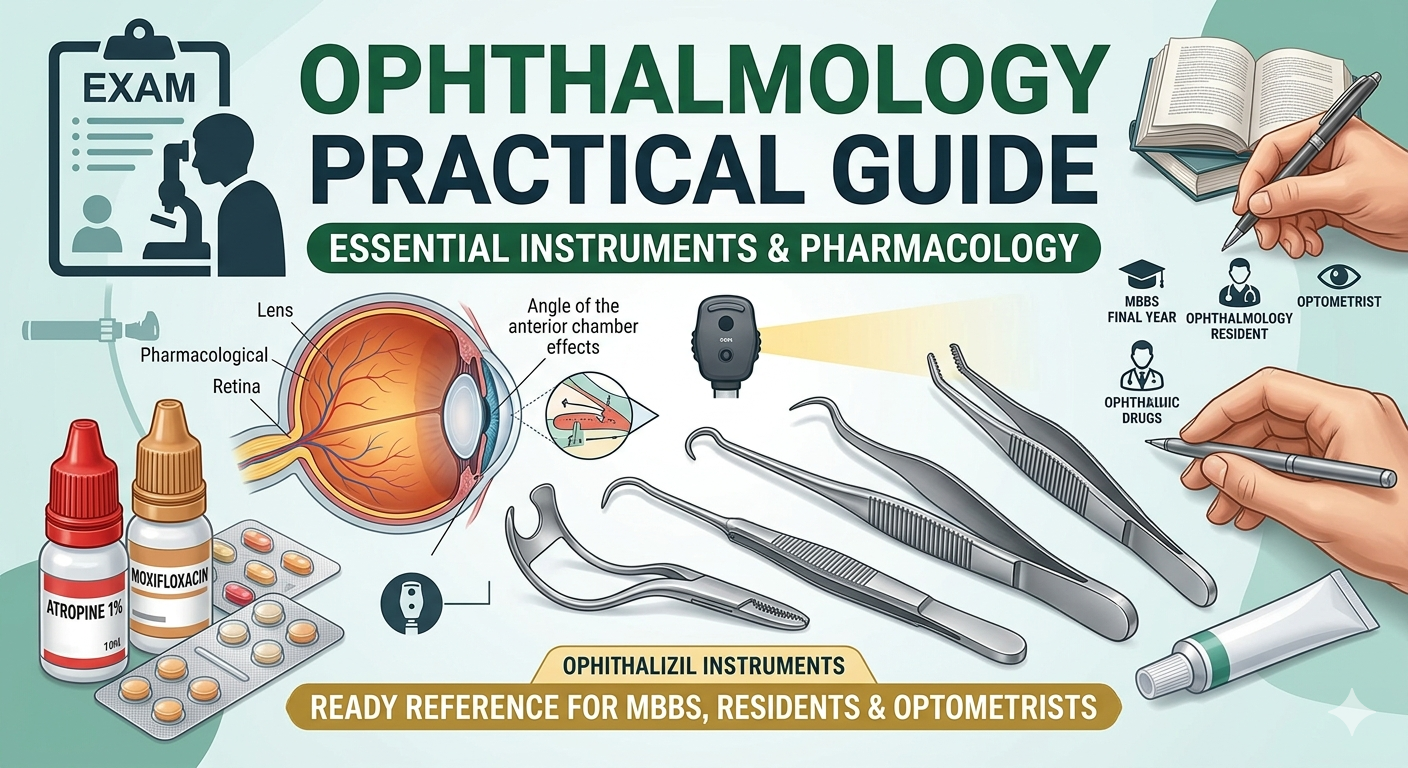
This comprehensive guide covers essential **ophthalmic instruments and pharmacological agents**, specifically curated for **MBBS final year students**, **ophthalmology residents**, and **optometrists** preparing for practical examinations and clinical rotations.
## 🛠️ Essential Ophthalmic Instruments
Mastering instrument identification and their clinical applications is critical for surgical proficiency and viva-voce success.
### 1. Lid Speculums
Used to keep the eyelids apart, ensuring clear exposure of the eyeball during surgery.
* **Universal Metallic Speculum:** Adjustable via a screw; used in extraocular procedures like pterygium excision.
* **Wire Speculum (Barraquer):** Lightweight and exerts minimal pressure; ideal for intraocular surgeries like cataract extraction.
### 2. Surgical Forceps
* **Superior Rectus Holding Forceps:** Stout, S-shaped curved forceps used to catch the superior rectus muscle for passing bridle sutures to stabilize the eye.
* **McPherson Forceps:** Angulated, toothless forceps used for holding Intraocular Lenses (IOL) during placement or removing capsular tags.
* **Fixation Forceps:** Medium-sized with 2:3 teeth; used to firm up the eyeball during procedures like paracentesis or cataract surgery.
* **Epilation (Cilia) Forceps:** Blunt flat ends used for mechanical removal of misdirected eyelashes in trichiasis.
### 3. Specialized Surgical Tools
* **Sinskey Hook (IOL Dialer):** An angular fine hook used to dial and center PMMA non-foldable IOLs.
* **Cystotome:** Often prepared from a 26G needle; used for performing anterior capsulotomy or capsulorhexis.
* **Simcoe Cannula:** A two-way irrigation-aspiration system used to remove cortical matter while keeping the anterior chamber formed.
* **Desmarre’s Lid Retractor:** Saddle-shaped tool for examining the conjunctiva and anterior segment, especially in children or patients with severe blepharospasm.
## 💊 Ophthalmic Pharmacology
Understanding drug delivery and common agents is vital for managing ocular pathologies effectively.
### 1. Mydriatics and Cycloplegics
Used for pupil dilation (mydriasis) and paralysis of accommodation (cycloplegia).
* **Atropine (1%):** The strongest cycloplegic; recovery takes 7–12 days. Used in iritis and amblyopia therapy.
* **Tropicamide (0.5–1%):** Fast-acting with a 6-hour recovery; ideal for diagnostic fundus examinations.
* **Phenylephrine:** A pure mydriatic (no cycloplegia); contraindicated in patients with narrow-angle glaucoma or hypertension.
### 2. Anti-Infective Agents
* **Antibacterials:** Includes **Fluoroquinolones** (Ciprofloxacin, Moxifloxacin) for corneal ulcers and **Aminoglycosides** (Gentamicin, Tobramycin) for conjunctivitis.
* **Antivirals:** **Acyclovir** and **Ganciclovir** (highly effective for CMV retinitis) are mainstay treatments.
* **Antifungals:** **Natamycin** (5% suspension) is a first-line treatment for fungal keratitis.
### 3. Anti-Inflammatory Agents
* **Steroids:** (e.g., Prednisolone, Dexamethasone) Used for uveitis and post-operative inflammation. **Caution:** Long-term use can lead to glaucoma and cataracts.
* **NSAIDs:** (e.g., Ketorolac, Nepafenac) Used for seasonal allergy and preventing cystoid macular edema (CME) after cataract surgery.
### 🎓 Practical Exam High-Yield Tips:
1. **Enucleation vs. Evisceration:** Remember enucleation removes the whole globe, while evisceration leaves the scleral shell and optic nerve intact.
2. **Instrument Identification:** Always look at the tip—toothed vs. plain and straight vs. curved—to distinguish between fixation and suture-tying forceps.
3. **Tapering Steroids:** Never stop topical steroids abruptly; they must be tapered to avoid rebound inflammation.
How are you feeling about identifying these instruments during your practical—any specific ones that always seem to look the same to you?
Student Reviews
What our students are saying about this course
No testimonials yet.
Loading...