If you're a postgraduate ophthalmology resident in India, AIOS-OKAT Module 1 is usually your first real national-level benchmark exam. Here's what it actually tests, and how to prepare for it without wasting time on the wrong material.
WHAT IS MODULE 1?
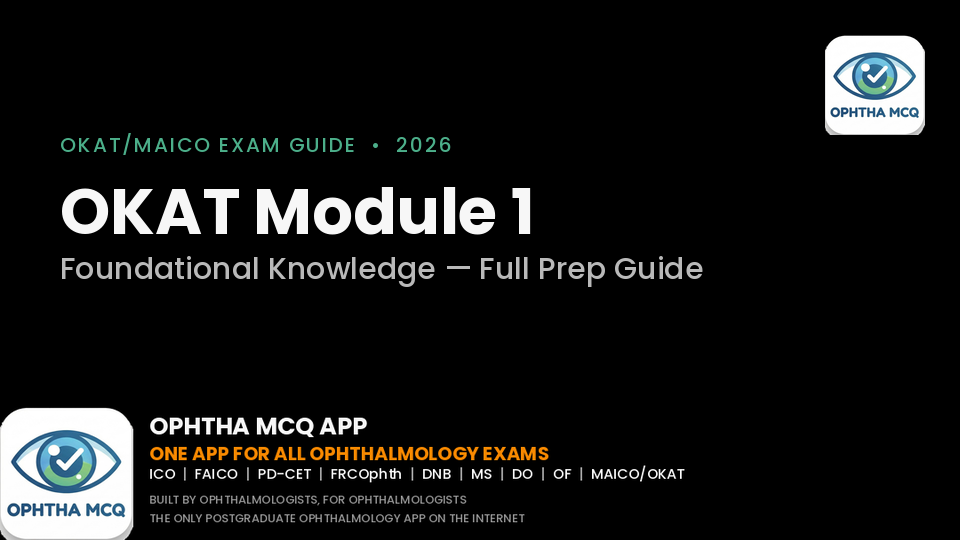
Module 1 (Foundational Knowledge) is an objective MCQ paper covering Basic Sciences, Optics & Refraction, and Clinical Examination Methods. It runs for 150 minutes with 150 MCQs, held on Day 1 Afternoon of the AIOS-OKAT test. Any MD/MS/DO/Primary DNB/Secondary DNB postgraduate student who has completed at least Year 1 is eligible to sit for it.
WHY MODULE 1 CATCHES RESIDENTS OFF GUARD
Most first-year residents assume "foundational" means easy. It doesn't — it means broad. You're tested on anatomy, physiology, pathology, microbiology, pharmacology, optics, refraction, and clinical examination technique all in one paper, at a PGY1-level depth defined by the AIOS National Curriculum. The difficulty isn't in any single topic — it's in the sheer spread.
HIGH-YIELD AREAS TO PRIORITISE
- Optics & Refraction: vergence and lens formulas, spherical/cylindrical/toric lens behaviour, ametropia and its optical correction, retinoscopy and subjective refraction principles, and instrument optics (slit lamp, direct/indirect ophthalmoscope, keratometer).
- Clinical examination methods: visual acuity testing and notation, applanation vs indentation tonometry (and why Imbert-Fick assumptions matter), direct ophthalmoscopy (upright, virtual image) vs indirect ophthalmoscopy (inverted, real image), and basic perimetry concepts.
- Basic sciences: ocular embryology milestones, layer-by-layer anatomy of the cornea/retina/uveal tract, and high-yield pharmacology (mechanism and major side-effect of each drug class you'll actually be asked about — glaucoma medications, cycloplegics, antibiotics).
WHY MODULE 1 MATTERS BEYOND JUST PASSING
Top-10 first-attempt scorers in each OKAT module receive AIOC registration and travel awards plus a merit certificate, and your OKAT score is one of the criteria used for AIOS National and International Fellowship and Travel Grant selection. First-attempt performance is what counts — there's real incentive to get this right the first time.
HOW OPHTHAMCQ HELPS
The AIOS-OKAT Module 1 MCQ Course: Foundational Knowledge on OphthaMCQ is built specifically against the AIOS National Curriculum's PGY1 tier — not an ICO or FRCS bank relabelled for OKAT. Every question is mapped to the actual Basic Sciences, Optics & Refraction, and Clinical Examination topics you'll be tested on, with explanations written by ophthalmologists who've been through these exams themselves.
Start Module 1 prep here: https://www.ophthamcq.com/new-courses/56-aios-okat-module-1-mcq-course-foundational-knowledge
Available on Android and iOs